












Risk factors

Diabetes is a complex and multifactorial disease. There are several variables – risk factors – that have been linked to prediabetes and diabetes, increasing the chances of developing it. In this section, you will find useful information about some of them.

Family hugging each other

family history
plays a role

When it comes to the risk of developing diabetes or prediabetes, family
history does play a role.

Having diabetes and developing diabetes-related complications is closely linked to factors that can either be influenced by personal or external circumstances, or those that are beyond individual control.1,2

In the first category, we group the things it’s possible to change or control, possibly modifying the outcome, like lifestyle choices, environmental circumstances, the socio-economic situation, and the country’s healthcare system approach to the disease.1,2

On the other hand, there are factors that remain unchanged, such as genetics.1,2

mother and daughter cooking

So, as we said, genes matter, but not everything is bad news. It is also up to environmental factors and very importantly, we cannot stress this enough, lifestyle choices.

Families have similar habits, whether we’re talking about diet (that can be poor) or exercise habits (or the lack of them). In most situations, it’s the combination of genetics and that particular lifestyle that leads to the outcome.

Children mimic adult behavior.
If their parents eat unhealthy food and live sedentary lives, it’s likely they will adopt the same actions. So, be a role model to your children (if you have them), you will be doing that for them, but also for yourself. Remember it’s possible to delay or prevent type 2 diabetes, in young age and in adults, by encouraging positive behavior.

Exercise, and
think about
making some
changes,
starting today!

Take
age
into account

There are many advantages with advancing age. You get wiser and more confident, but as always, there are two sides of the same coin… you may also need to pay a close attention to your health.

girl with glasses thinking

Making an appointment to see your doctor and scheduling a health checkup is always a good idea, at any age.
But, all adults should be screened for prediabetes and diabetes beginning at age 35 years.1

Age is a risk factor for prediabetes and diabetes, one that is not up to you to control, of course. However, there are other lifestyle changes within your reach that will help to reduce it, like:4

By doing this, you will also be minimizing the risk of having other cardiovascular problems like strokes or heart attacks4, so that’s an extra incentive not to wait any longer.
We are here to help; in this page you will find plenty advice on how to live a more balanced life, both physically and mentally, regardless of your situation – either you just found out you have prediabetes, you were recently diagnosed with diabetes, or you have already been on this path for some time.

Let’s continue the journey.

Today is as good as any day
to start exercising!

Looking for a sign that is time to
start your exercise plan?

Here it is.

Being active helps your body to better control blood sugar levels. Exercise also helps muscles to use insulin more efficiently, putting less stress on the insulin-producing cells.5

And it doesn’t end there. There are many other benefits in adopting an active lifestyle:6

150 minutes of exercise per week
is the minimum recommend amount
in order to reduce the risk of
developing type 2 diabetes

You may wonder, how can you motivate yourself to achieve this goal? Start by taking simple steps and incorporate small changes in your daily routine. We can help you with some basic points:6

And one more practical tip: at home, try to stand up while watching TV and maybe walk around a bit during commercial breaks.

No step is too small,
even 10 to 15
minutes per day may
provide benefits!

climb stairs

Manage the weight

Couple preparing salad

You can be just a few steps away from achieving a better and healthier version of yourself.

Diabetes prevalence is rising globally, with approximately 537 million adults living the condition.7

This growing numbers are due to many different factors, namely an ageing population and a more sedentary lifestyle – especially in urban areas. This new paradigm is associated with a larger intake of unhealthy foods and that contributes to obesity.7

Did you know that if you are above the healthy-weight range, losing 5 to 7 % of your current weight can prevent or delay development of type 2 diabetes?8

Being overweight (abnormal or excessive fat accumulation that presents a risk to health; a body mass index over 25 is considered overweight) might affect your health and obesity (a body mass index over 30) is an important modifiable risk factor for type 2 diabetes, which means there are things that can be done to minimize that risk. Losing those extra weight will help lowering your blood sugar and increasing insulin sensitivity making managing your blood sugar easier.
Need an extra incentive to start your fitness journey? Why not try:6

These can be free
and appropriate
first steps towards
a healthier life.

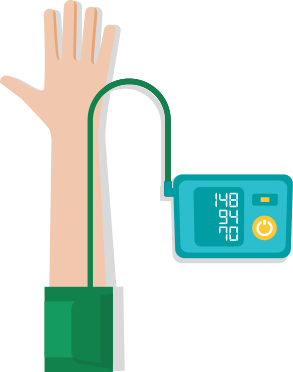
Monitor your
blood pressure!

Did you know that 2 out of 3 people with diabetes report having high blood pressure or take prescription medications to lower their blood pressure?9

Yes, monitoring your blood glucose is important (very important), especially if you have diabetes, but listening to your heart should also be top priority.

Patients with diabetes are at higher risk of cardiovascular disease when compared to those without diabetes.10 Also, prediabetes increases already the risk of microvascular and macrovascular events.

An optimized glycemic control, weight goals, exercising the right amount and exposure to less harmful environmental factors (like air pollution) are all key to achieve the desirable blood pressure control.10

A goal of less than 130/80 mmHg should be kept in mind in most patients with diabetes who are at higher risk of cardiovascular disease.10

When the blood pressure is high (which means that the force of the blood flow inside the blood vessels is elevated), the heart must make an extra effort and therefore, the risk of heart related problems, like heart disease and stroke, goes up.9

Regular checkups should take place in order to tackle this problem, as this can be a silent condition, with no evident symptoms. The ideal annual screenings should aim to prevent complications and make room for preventive treatments to stop the disease from progressing. Being aware of this and adopting a better lifestyle management will certainly help people with type 2 diabetes to live long and healthy lives.7

Here are some practical
tips on how to lower your
blood pressure:9

And talk to your health care provider to establish a treatment course that is individualized and targeted to you and your needs.

Wondering if you are
at risk of having prediabetes
or diabetes?

Take the test
REFERENCES

1. American Diabetes Association Professional Practice Committee. 2. Classification and Diagnosis of Diabetes: Standards of Medical Care in Diabetes—2022. Diabetes Care. 2022;45(1): S17–S38. https://doi.org/10.2337/dc22-S002 Accessed November 2022.
2. Karatzi K, et al. The Role of Lifestyle, Eating Habits and Social Environment in the Prevention and Treatment of Type 2 Diabetes and Hypertension. Nutrients. 2021;13(5):1460.
3. ADA. Learn the Genetics of Diabetes. Available at: https://www.diabetes.org/diabetes/genetics-diabetes. Accessed June 2022.
4. AHA. Preventing and Treating Diabetes. Available at: https://www.heart.org/en/health-topics/diabetes/prevention–treatment-of-diabetes. Accessed June 2022.
5. Colberg SR, et al. Diabetes Care 2016; 39(11):2065–79.
6. Merck. Home Truths Report. 2021.
7. IDF Diabetes Atlas 10th edition – 2021. Available at: https://diabetesatlas.org/. Accessed June 2022.
8. Hamman RF et al. Diabetes Care. 2006; 29(9):2102–7.
9. ADA. Diabetes and High Blood Pressure. Available at: https://www.diabetes.org/diabetes/high-blood-pressure. Accessed June 2022.
10. Naha S, et al. Hypertension in Diabetes. 2021. In: Feingold KR, et al., editors. Endotext [Internet]. South Dartmouth (MA): MDText.com, Inc.; 2000–2021. PMID: 25905256.

GL-GLUP-00129